
How Long Should Your Water Softener Last?
(Kinetico vs. Big Box & Online Brands)
Investing in a water softener is one of the most effective ways to protect your home’s plumbing, extend the life of your water-using appliances, and enjoy clear, scale-free water. However, when shopping for a system, one crucial factor often gets overlooked: lifespan.
Not all softeners are built equal. A quick trip to a local home improvement store or an evening scrolling through online retailers will reveal options priced under $600, while professionally installed, engineered non-electric systems sit at a higher investment level.
So, how long should a water softener actually last, and is a premium brand like Kinetico worth the investment compared to a big box store or online model?
The Average Lifespan: Quick Overview
| System Category | Typical Brand Examples | Average Expected Lifespan | Primary Drive Mechanism |
| Big Box Store Brands | Rheem, Whirlpool, GE, Morton | 3 to 7 years | Electric timer / single-tank cabinet |
| Online Direct-to-Consumer | Fleck-based kits, Aquasure, Water2Buy | 8 to 12 years | Electric control valve / modular dual-tank |
| Premium Non-Electric | Kinetico | 15 to 20+ years (often 25–30) | Kinetic water-driven kinetic valve / dual-tank |
1. Big Box Store Softeners (Retail Brands)
-
Average Lifespan: 3 to 7 Years
-
Upfront Cost: Low ($400 – $800)
Build & Mechanical Limitations
Big box softeners are typically designed as “cabinet models”—where the resin tank and salt brine tank share a single plastic housing. To keep price points low, manufacturers use plastic valve components, thinner resin beads, and electronic circuit boards that sit directly inside a high-moisture environment right above the salt reservoir.
Why They Fail Sooner
-
Corrosive Environment: Salt vapor and humidity inside the cabinet ruin the internal electronic circuit boards and solenoids.
-
Resin Degradation: Lower-grade resin beads break down quickly, especially when exposed to chlorine or iron in municipal or well water.
-
Single-Tank Downtime: Because they use single-tank configurations, they must regenerate in the middle of the night on a timer or estimate, leading to hard water bleed-through or wasted salt and water.
-
Lack of Repair Parts: When an internal valve or board fails after 4–5 years, replacement parts are often obsolete or cost nearly as much as buying a brand-new unit.
2. Online Vendors & Direct-to-Consumer Kits
-
Average Lifespan: 8 to 12 Years
-
Upfront Cost: Moderate ($600 – $1,500)
Build & Mechanical Limitations
Systems bought online often feature independent resin and salt tanks with heavy-duty industry control valves (such as Clack or Fleck valves). These offer a noticeable step up in quality compared to big-box all-in-one cabinets.
Why They Offer Mid-Range Longevity
-
Separated Tanks: Keeping the salt storage separate from the control head protects electronic components from immediate salt corrosion.
-
Modular Parts: When a seal kit, motor, or circuit board fails, replacement parts are readily available online for DIY replacement.
-
The Catch: Longevity depends heavily on proper sizing and installation quality. Incorrect sizing, poor water pre-treatment (like unaddressed iron or high chlorine), or improper plumbing can cut the lifespan of an online system in half.
3. Kinetico Water Softeners
-
Average Lifespan: 15 to 20+ Years (Many operate 25 to 30+ years)
-
Upfront Cost: Higher initial investment
The Kinetico Difference: Built for the Long Haul
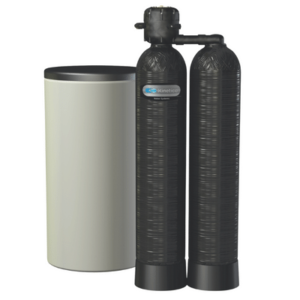 Kinetico systems are engineered using a fundamentally different approach than standard softeners:
-
Non-Electric Operation: Kinetico systems use the kinetic energy of moving water to power the meter and regeneration valve rather than electric circuit boards, motors, or timers. No electronics means no boards to fry during power surges or corrode from damp salt air.
-
Twin-Tank Design: Standard systems soften water until they run out of capacity and then wait for an electronic timer to regenerate. Kinetico’s dual-tank design provides 24/7 continuous soft water. When Tank A exhausts its capacity, Tank B seamlessly takes over.
-
Soft-Water Regeneration: Big box and entry-level softeners clean their resin beds using untreated hard water. Kinetico uses softened water to clean itself, preventing mineral build-up inside the valve components and keeping high-grade resin intact for decades.
-
Commercial-Grade Resin: Premium non-electric systems utilize fine-mesh, high-capacity resin that resists chlorine breakdown and iron fouling far longer than standard consumer-grade resin.
What Factors Impact Water Softener Lifespan?
Regardless of the brand you choose, several operational factors determine whether your system hits the lower or upper end of its expected life:
-
Raw Water Quality: High levels of iron, manganese, sediment, or hydrogen sulfide put extra stress on resin and internal seals. Pre-filtration is essential for long system life.
-
Chlorine & Chloramines: City water additives break down resin beads over time, turning them into a mushy gel that restricts water pressure.
-
Water Usage & Hardness: The harder your water and the higher your household usage, the more cycles the system performs, accelerating wear on moving parts.
-
Maintenance Practices: Keeping salt bridges from forming, using pure evaporated salt, and cleaning the brine tank every few years prevents premature valve clogs.
The True Cost of Ownership: Short-Term Savings vs. Long-Term Value
While a $500 big box softener is appealing on paper, replacing it every 4 to 6 years means purchasing 3 to 4 units over a 20-year span—not including installation costs, frequent salt usage, and water wasted during inefficient regeneration cycles.
Investing in a premium system like a Kinetico provides reliable performance, lower salt and water consumption, and decades of hassle-free soft water without frequent structural failure.